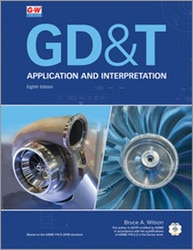


GD&T: Application and Interpretation, 8th Edition
• Master GD&T concepts and ASME Y14.5 standards for design, manufacturing, and inspection.
• Learn tolerance application and interpretation through clear 3D models and illustrations.
• Build industry-ready skills with practical examples, expert tips, and real-world applications.
Title Overview
Title Overview
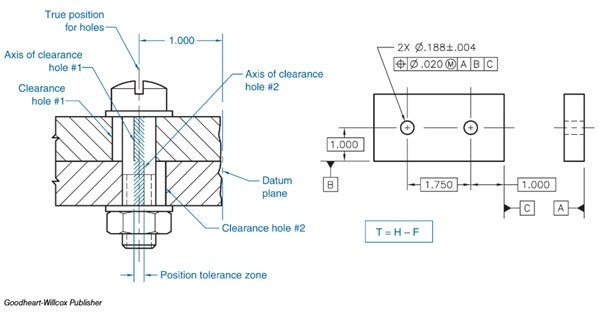
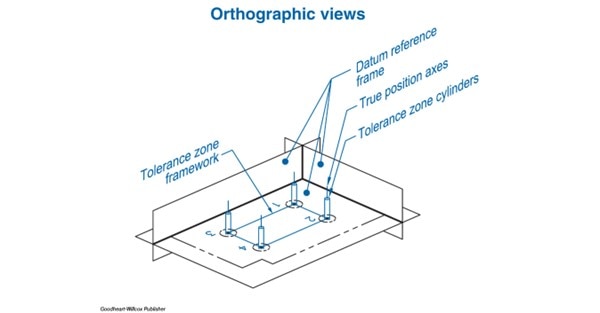
GD&T: Application and Interpretation, based on the ASME Y14.5-2018 standard, is targeted to entry-level and advanced programs that require a study of geometric dimensioning and tolerancing as related to design, manufacturing, or inspection. The sequence of chapters is closely tied to the organization of topics in the ASME Y14.5 standard, with topics ranging from the fundamentals of dimensioning to the extended principles of tolerance application and interpretation. Illustrations are used extensively to clarify explanations in the text and show applications in three-dimensional (3D) models and orthographic views. The author is certified by ASME as a Senior Level Geometric Dimensioning and Tolerancing Professional and has participated in the development of national and international standards for more than 25 years.
- Provides in-depth explanations of the practices presented in the ASME Y14.5 standard, ensuring learners are mastering the latest industry standard.
- The text includes hundreds of figures to illustrate ASME Y14.5 practices, and color is used in figures to separate explanation data from the main portion of the figure.
- Boxed features, including Pro Tips, Standards Advisory, Notes, Past Practice, and History Brief, highlight critical, difficult-to-understand, and historical topics.
Table of Contents
Table of Contents
1. Introduction to Dimensioning and Tolerancing
2. Dimensioning and Tolerancing Symbology
3. General Dimensioning Requirements
4. Dimension Application and Limits of Size
5. Form Tolerances
6. Datums and Datum Feature References
7. Orientation Tolerances
8. Position Tolerancing Fundamentals
9. Position Tolerancing - Expanded Principles
10. Runout
11. Profile
12. Practical Applications and Calculation Methods
Instructor Resources
Instructor Resources
Hit the ground running with G-W's Online Instructor Resources that save you time and make it easier to prepare for class, reinforce new concepts, and assess learning. Created by educators for educators, these complete teaching packages are ready to go and will instantly make a difference in your class. Best of all—Instructor Resources are free with qualified purchases!
- Lesson Plans and Activities
Experienced teachers have developed detailed lesson plans and creative activities to accompany the textbooks. There's no need to spend days recreating your courses—they have done it for you! - PowerPoint Presentations
Editable slides for each chapter engage a variety of learning styles, improve student focus, encourage discussion, and provide visual impact. - Workbooks
Creative workbook activities inspire students to review and apply concepts. - Interactive Content
Additional interactive content including flash cards, animations, and interactive activities enhance the learning experience. - Assessments
The new cloud-based G-W Assessment platform allows you to create, customize, assign, and print prebuilt questions and tests. No more downloads, uploads, or imports needed! Integrate it with your LMS for autograded assignments, advanced reporting, and scores that flow into your gradebook.
Look Inside
Look Inside
The Look Inside is for preview purposes only. The format of the actual product may vary from the image shown.
Text

About the Author
About the Author
Course Content
What Educators Are Saying
 This text does a great job covering the symbols and how to use all of them individually. I think it has solid content that is well organized and teachable.
Brian Clinch, Southeast Community College, NE
You Might Also Like